Storm Season and Liability: Who Pays When a Tree Falls on a Neighbor’s Car?
When a storm drops a tree onto a neighbor's car, the answer to 'who pays?' is rarely the tree's owner — unless negligence is involved. Here's how the law and the insurance actually work, and what to document.
A fall storm drops your oak across the property line onto your neighbor’s parked car. Who pays? Usually their insurance, not yours — unless you knew the tree was dangerous and did nothing. Here’s how negligence, “acts of God,” and two different insurance policies sort out the answer.
Key takeaways
A healthy tree felled by a storm is generally treated as an act of God — the tree’s owner is typically not liable, and each property owner handles their own damage.
Negligence flips the outcome. If the owner knew (or should have known) the tree was dead, rotting, or hazardous and failed to act, they can be held responsible.
Insurance follows the damage, not the tree. Your homeowners policy covers damage to your insured structures no matter whose tree fell; a neighbor’s car is covered by their auto policy’s comprehensive coverage.
Your insurer may pursue the neighbor’s insurer (subrogation) if the tree was poorly maintained — and you could get your deductible back.
Document everything: photos, dates, and any written warnings about the tree’s condition, from either side of the fence.
In most US states, the outcome turns on one question: was the tree healthy, or was it a known hazard?
If a healthy tree is brought down by wind, lightning, or a storm, courts generally treat it as an act of God — a natural event nobody could have prevented. The tree’s owner typically owes the neighbor nothing, even though the tree started on their land. Each side deals with the damage on their own property through their own insurance.
If the tree was visibly dead, diseased, or structurally unsound — and the owner knew or reasonably should have known — that’s negligence. A property owner who ignores an obvious hazard can be held financially responsible for what it damages.
Laws vary by state and facts always matter — treat this as the general framework, not a ruling. Anything beyond concepts is a conversation for a licensed attorney in your state.
Track one: the healthy tree and the act of God
Picture the most common version of this story: a mature, leafy, apparently solid oak. No dead limbs, no lean, no fungus at the base. A fall storm — the kind with a name on the weather radio — snaps it at the trunk and lays it across your neighbor’s sedan.
Under the negligence standard most states apply to tree disputes, the tree’s owner had no duty to prevent what no one could foresee. Courts have repeatedly held that a landowner isn’t liable for damage from a natural condition they had no reason to consider dangerous. The storm did it; the owner didn’t.
This is why the practical answer surprises people: the neighbor files with their own insurer, not yours. Your homeowners policy doesn’t pay for their car — it was never designed to. Their auto policy’s comprehensive coverage (the part that covers fire, theft, vandalism, hail, and falling objects) is the coverage that responds to a tree landing on a car. If they only carry liability on an older vehicle, there may be no auto coverage at all — which is a painful lesson, but not one that creates liability for you.
The same logic runs in reverse, and it’s worth internalizing: if their healthy tree crushes your fence, you’re generally dealing with your own homeowners policy. The law treats both sides symmetrically.
Track two: negligence — when the owner knew better
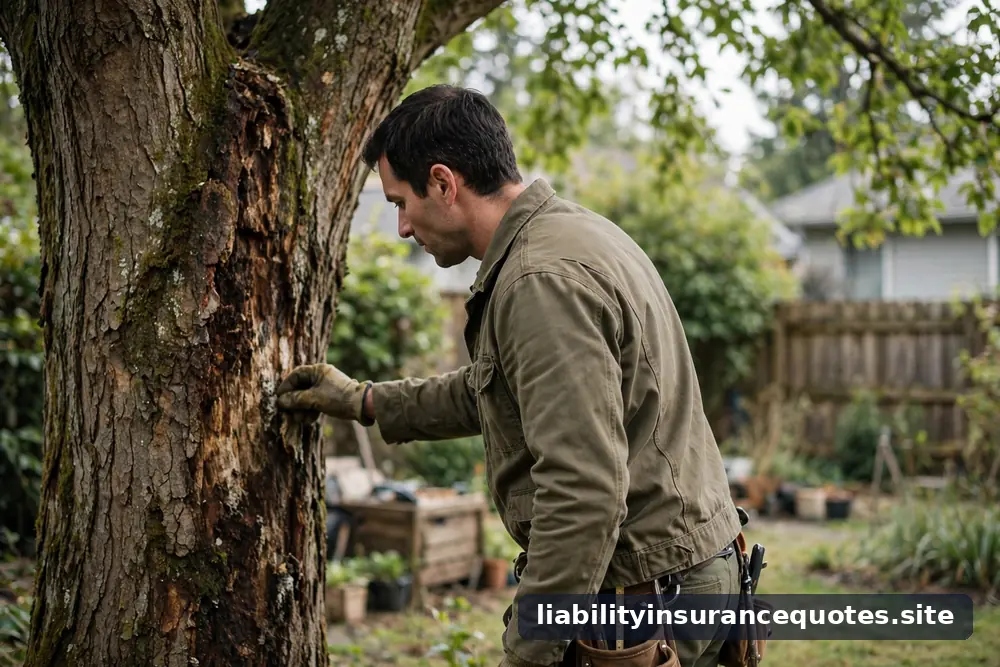
Now change one fact: the oak had been dead for two summers. Bark peeling, no leaves, a visible lean toward the neighbor’s driveway. You’d mentioned it to the owner last spring. Then the storm finished what rot started.
That’s a different case. The legal standard asks whether the owner knew — or reasonably should have known — that the tree was hazardous and failed to eliminate the danger. Courts look for warning signs an ordinary person would notice: large dead limbs, visible decay or fungus, a pronounced new lean, hollow sections in the trunk, roots heaving out of the ground.
Notice is the hinge. A certified letter or even a dated email to the neighbor saying “your dead maple is leaning over my garage” creates a record that the owner was warned. Without notice, the owner can credibly say they never realized; with it, “I didn’t know” stops working.
Two cautions. First, “should have known” doesn’t mean you’re expected to hire an arborist annually — it’s judged by what an ordinary person would observe. Second, some states apply the older common-law rule more strictly for purely natural conditions, while others have adopted the negligence standard by statute or case law. The trend favors negligence, but your state’s exact rule is a legal question, not an insurance one.
What the insurance actually pays
Separate the legal question (who’s at fault) from the insurance question (who pays for what). The Insurance Information Institute (III) lays out the insurance mechanics clearly: (Source: III)
If a tree hits your insured structure — your house, a detached garage — your standard homeowners policy covers the damage to the structure and its contents. This holds for trees felled by wind, lightning, or hail, and it doesn’t matter who owned the tree. If it lands on your home, you file with your insurer.
Tree removal is covered when the tree hit an insured structure — generally in the range of about $500 to $1,000 depending on the insurer and policy. But if the fallen tree hit nothing insured and is just lying in the yard, there’s generally no coverage for debris removal — with a narrow exception some insurers allow when the tree blocks a driveway or a handicap-access ramp.
Subrogation is where negligence re-enters the insurance picture. If the tree came from the neighbor’s property and was in poor health or poorly maintained, your insurer may try to collect from the neighbor’s insurer. If that succeeds, you can be reimbursed for your deductible. This is the insurer’s fight, not yours — but it only happens when there’s evidence of poor maintenance, which is another reason documentation matters.
The neighbor’s car is an auto insurance matter. Comprehensive coverage on their auto policy covers falling objects including trees. Your homeowners policy — including its liability section — doesn’t pay for their car unless you’re legally liable for the damage (back to the negligence question).
Your own damaged trees and shrubs have limited coverage: standard policies cover them against specific perils (fire, lightning, vandalism, and similar), generally capped at a percentage of the structure coverage, with most insurers limiting it per individual tree or plant. Trees grown for business purposes need separate business coverage.
Your liability coverage’s role in all this
This is the part people get backwards. Your homeowners personal liability coverage pays when you’re legally responsible for injury or damage to others. In the healthy-tree scenario, you’re not legally responsible — so your liability coverage has no role, and the neighbor can’t successfully claim against it.
In the negligence scenario, your liability coverage is exactly what responds: it pays for the neighbor’s property damage and provides your legal defense, up to your limit. That’s the coverage doing the job it was designed for.
The practical implication: liability coverage can’t create responsibility where none exists, and it can’t be invoked by an angry neighbor as a matter of right. It follows a finding (or a credible threat) of legal liability. Our guide to what liability insurance covers — and what it never does maps these boundaries in full.
The documentation habit that protects both sides
Whether you’re the tree’s owner or the neighbor, the same habit protects you: a dated paper trail about the tree’s condition.
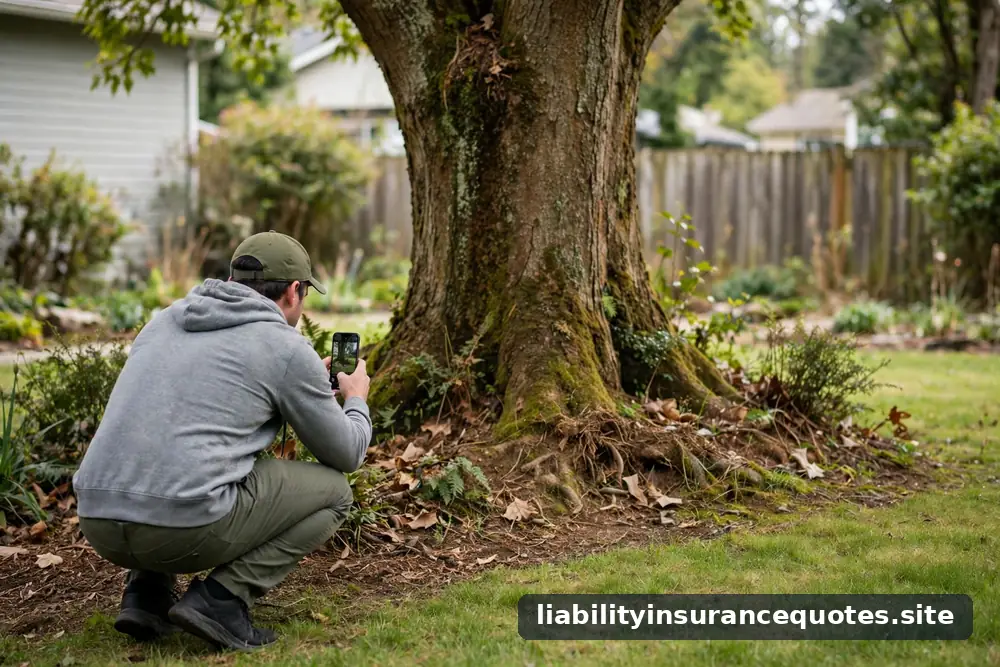
If you own large trees near a property line, photograph them once a season — wide shots showing overall health, close-ups of the trunk base. If you hire an arborist for trimming, keep the invoice and any written assessment. If a neighbor ever mentions concern about your tree, keep that communication and act on it; a warning you ignored is the centerpiece of a negligence claim.
If you’re the neighbor worried about someone else’s tree, put the concern in writing — a polite dated letter or email describing what you observe (“the maple on your side has been leafless two summers and now leans toward our driveway”). Keep a copy. You’re not building a lawsuit; you’re creating the notice that makes the owner take the hazard seriously, which is what you actually want.
After a fall, document before cleanup: wide photos of the scene, close-ups of the break point (a clean snap vs. rotted wood tells a story), the tree’s overall condition, damage to structures and vehicles, and the date and weather. If anyone is hurt, that documentation goes to your insurer immediately — and if injuries are serious, to an attorney before you discuss fault with anyone.
The first 48 hours after it happens
Storm damage is disorienting, so here’s the sequence:
Safety first. Downed trees can hide live power lines. Don’t touch anything near lines; call the utility. If the tree hit your home and the structure looks compromised, stay out until it’s assessed.
Mitigate further damage. Tarps over roof holes, moving valuables — insurers expect reasonable steps to prevent the damage from getting worse, and our walkthrough of how to file a liability insurance claim covers the documentation standards adjusters look for.
Call your insurer and report the facts. Report what happened, not who’s at fault — fault is for the adjusters and, if it comes to it, the courts.
Don’t admit fault or promise payment to the neighbor in the moment, even if you feel responsible. A sympathetic “let’s both call our insurers and sort this out properly” preserves everyone’s options.
Get the tree assessed if its condition is in question — an arborist’s written opinion about whether it was healthy or hazardous is the single most useful piece of evidence either side can have.
Frequently asked questions
My neighbor’s healthy tree fell on my car during a storm. Can I make them pay?
Generally no — a healthy tree felled by a storm is treated as an act of God, and the tree’s owner typically isn’t liable. Your auto policy’s comprehensive coverage is the coverage that responds. If you don’t carry comprehensive, the repair cost may fall on you.
What if I warned my neighbor their tree was dead and they ignored me?
That written warning is significant. An owner who had notice of a hazardous tree and failed to act can be found negligent and held responsible for resulting damage. Keep copies of every communication.
Does my homeowners insurance cover removing a tree that fell in my yard but hit nothing?
Generally no — III notes there’s typically no debris-removal coverage when no insured structure was hit, though some insurers make an exception if the tree blocks a driveway or handicap-access ramp.
The tree was on the property line. Whose tree is it?
Boundary-tree ownership rules vary by state — some treat each owner as responsible for their side, others apply shared-ownership concepts. This is genuinely a legal question for your state, and it’s one of the situations where a brief attorney consultation earns its keep.
Should I file a claim if the damage is minor?
Consider your deductible first, and remember that claims history can affect future premiums. For damage near or below your deductible, paying out of pocket is often the calmer choice. Document anyway.
Your concrete next step
This week, walk your property line and really look at your trees — and your neighbor’s. Any large dead limbs, lean, fungus, or hollow spots near structures, driveways, or parked cars deserve a photo and, if they’re not yours, a polite dated note to the owner. It takes twenty minutes, it costs nothing, and it’s the single habit that prevents most tree disputes from ever starting. To understand exactly where your homeowners liability begins and ends, see our tour of homeowners personal liability coverage.
This article is general educational information about liability concepts and insurance mechanics, not legal or insurance advice. Tree-damage liability rules vary by state — consult a licensed attorney for your specific situation.